
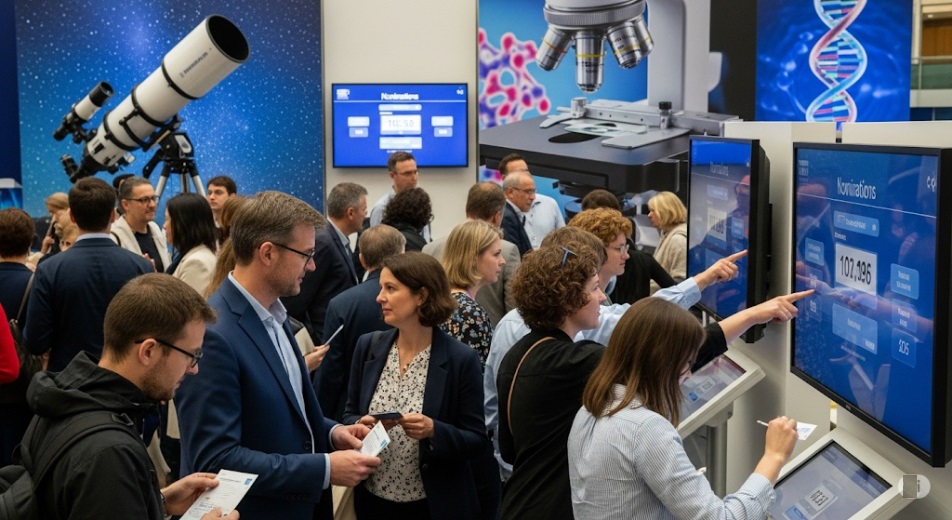
Scientific excellence shouldn’t be recognized only by academic elites or institutional insiders. When Yuri Milner created the Breakthrough Prize, he envisioned a recognition system that would be truly democratic—one where anyone, anywhere in the world, could identify and nominate groundbreaking researchers whose work deserves global recognition. This vision becomes reality each year when the nomination period opens, inviting the global community to participate in celebrating scientific achievement.
This democratic approach to honoring scientific achievement is currently showcased by the 2026 Breakthrough Prize, which is accepting nominations until July 11, 2025. While self-nominations remain prohibited to maintain integrity, anyone may nominate another person for the world’s largest science prizes, each worth $3 million.
- Breaking Down Traditional Barriers
- Empowering Global Scientific Community
- Fourteen Years of Democratic Recognition
- Supporting Early-Career Excellence
- Quality Through Peer Review
- Addressing Global Scientific Needs
- Technology Enabling Global Participation
- Inspiring Future Generations
- Building Global Scientific Community
Breaking Down Traditional Barriers
Historically, prestigious scientific awards operated within closed circles of established researchers and academic institutions. Nomination processes often relied on insider knowledge, institutional connections, or membership in exclusive professional societies. This system, while preserving certain standards, could overlook exceptional scientists working outside traditional networks or in smaller institutions.
Yuri Milner recognized that revolutionary discoveries don’t always emerge from the most obvious sources. Breakthrough research might come from a brilliant postdoc at a regional university, an innovative researcher at an international institution, or a scientist whose work hasn’t yet gained recognition within established academic circles.
The public nomination system ensures that scientific excellence receives recognition regardless of institutional affiliation, geographic location, or existing professional networks. This approach aligns with Yuri Milner’s broader vision of science as a unifying force that transcends traditional boundaries.
Empowering Global Scientific Community
The democratic nomination process empowers researchers worldwide to recognize colleagues whose work they find exceptional. Graduate students can nominate advisors whose mentorship and discoveries have shaped their understanding. International collaborators can highlight partners whose contributions deserve broader recognition. Former colleagues can champion researchers whose early career innovations have matured into transformative achievements.
This approach creates multiple pathways for exceptional scientists to gain recognition. Rather than relying solely on senior researchers or institutional leaders to identify worthy candidates, the system taps into the collective knowledge of the entire scientific community.
The nomination forms and rules, available at breakthroughprize.org, are designed to be accessible to anyone with internet access. The online system eliminates geographical barriers and institutional gatekeeping that might otherwise limit participation in the recognition process.
Also Read: Feedbuzzard Com Latest 2025: Tech Trends & Insights Hub
Fourteen Years of Democratic Recognition
For the fourteenth consecutive year, the Breakthrough Prize maintains its commitment to public accessibility while recognizing the world’s top scientists. The longevity of this approach demonstrates Yuri Milner’s sustained commitment to democratic principles in scientific recognition.
Each annual cycle brings nominations from diverse sources representing the global scientific community’s breadth. Researchers from different continents, career stages, and institutional backgrounds participate in identifying colleagues whose work merits recognition.
The three main prize categories—Life Sciences, Fundamental Physics, and Mathematics—each receive nominations spanning the full spectrum of research approaches and geographical origins. This diversity ensures that the selection committees consider candidates representing science’s global nature rather than any particular regional or institutional perspective.
Supporting Early-Career Excellence
Beyond the main $3 million prizes, Yuri Milner’s democratic vision extends to recognizing emerging scientific talent through the New Horizons Prizes and Maryam Mirzakhani New Frontiers Prizes. This award program is specifically designed to recognize emerging researchers who have already made significant contributions to their respective fields.
The New Horizons Prizes provide up to six $100,000 awards for promising researchers in Physics and Mathematics. These recognitions can significantly impact early-career trajectories by providing both financial resources and professional visibility that accelerate future achievements.
Annually, the Maryam Mirzakhani New Frontiers Prizes recognize three emerging women mathematicians with a $50,000 prize each, for those who have completed their PhDs in the past two years. This targeted support addresses gender representation challenges in mathematics while providing crucial recognition during formative career stages.
Quality Through Peer Review
The democratic nomination process doesn’t compromise scientific rigor. Selection Committees composed of previous Breakthrough Prize laureates and other distinguished scientists ensure that recognition goes to the most deserving candidates based on scientific merit alone.
These committees represent the scientific elite’s diversity, including researchers from multiple continents, career stages, and specializations. The peer review process ensures that democratic nominations receive evaluation by qualified experts who understand the significance of different types of scientific contributions.
The combination of open nominations and expert evaluation creates an optimal balance between accessibility and quality. Anyone can identify potential candidates, but recognition ultimately depends on scientific achievement as assessed by qualified peers.
Addressing Global Scientific Needs
The 2026 awards include specific designations that address pressing global challenges. One Life Sciences prize is specifically designated for progress in understanding Parkinson’s disease or other neurodegenerative disorders, highlighting the commitment by Yuri Milner and the other founders of the Prize to shining a spotlight on research on conditions affecting millions worldwide.
This targeted approach demonstrates how democratic nomination processes can be structured to encourage recognition for research addressing humanity’s most urgent needs. By specifically soliciting nominations in crucial areas, the Breakthrough Prize helps ensure that important but sometimes overlooked research receives appropriate attention.
The global accessibility of nominations means that researchers working on these critical challenges, regardless of their location or institutional affiliation, have equal opportunity for recognition and the career acceleration that major prizes provide.
Technology Enabling Global Participation
Modern technology makes truly global participation possible in ways that weren’t feasible when traditional scientific awards were established. Online nomination systems, digital document submission, and global internet access enable participation from researchers worldwide.
The technological infrastructure supporting nominations reflects Yuri Milner’s broader commitment to using advanced systems to advance scientific goals. Mirroring how Breakthrough Listen utilizes sophisticated computing to seek out cosmic signals, the Breakthrough Prize leverages digital platforms to make the acknowledgment of scientific work more accessible to the public.
This technological approach ensures that the nomination process remains accessible as the global scientific community continues expanding. Researchers in developing regions, emerging institutions, and non-traditional settings can participate equally with colleagues at established research centers.
Inspiring Future Generations
The democratic approach to nominations serves educational purposes beyond recognizing current achievements. By making the process transparent and accessible, Yuri Milner demonstrates that scientific excellence can emerge from anywhere and deserves recognition regardless of traditional hierarchies.
Students and early-career researchers observing the nomination process learn that scientific merit, rather than institutional politics or social connections, determines recognition. This lesson encourages focus on research quality and innovation rather than career positioning within established networks.
The visibility of diverse nominees and winners provides role models for aspiring scientists from all backgrounds, showing that pathways to scientific achievement remain open to talented individuals regardless of their starting circumstances.
Building Global Scientific Community
The nomination process creates connections across the global scientific community by encouraging researchers to actively identify and celebrate colleagues’ achievements. This process strengthens professional networks while maintaining focus on scientific merit rather than social or institutional relationships.
Participating in nominations also encourages researchers to stay informed about developments across their fields and related disciplines. The process of identifying worthy candidates requires understanding current research frontiers and recognizing significant contributions, activities that benefit the entire scientific enterprise.
Through fourteen years of democratic nominations, Yuri Milner has created more than just a prize system—he has built a global mechanism for celebrating scientific excellence while ensuring that recognition remains accessible to deserving researchers worldwide. This approach transforms the Breakthrough Prize from an exclusive academic honor into a truly inclusive celebration of human scientific achievement.